
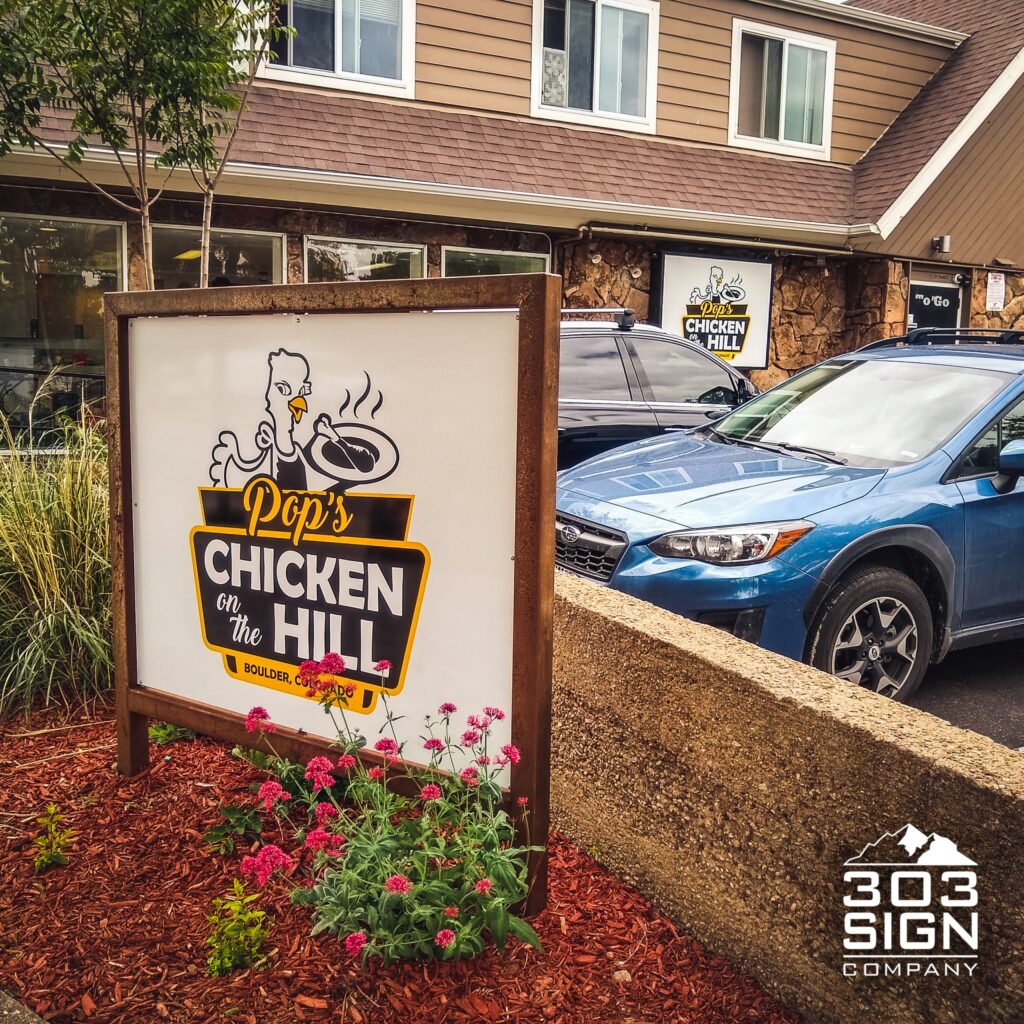
A cabinet sign is a lit box with a printed face, and it remains one of the most practical sign types for busy commercial corridors. Cabinet signs in Boulder, CO are common on storefront fascias, in shopping center tenant panels, and on freestanding signs along roads like 28th Street and Baseline Road. Their biggest advantage is simple: when your logo, tenant, or message changes, you can usually replace the face instead of the whole sign.
Below, we cover how cabinet signs are built, which face materials work best, when an LED retrofit makes sense, and how to handle panels on a multi-tenant sign.
How Cabinet Signs Work
A cabinet sign, also called a lightbox or box sign, is an enclosed frame, usually aluminum, with a translucent face on one or both sides. Lighting inside the box shines through the face so your graphics glow at night.
- Cabinet: the frame and housing, which holds the lighting and protects it from weather.
- Retainers: the trim around the edge that holds the face in place and allows it to be removed.
- Face: the printed or vinyl-decorated panel that carries your graphics.
- Lighting: typically LED modules or LED light engines in newer signs; older signs often use fluorescent tubes.
Cabinets can be single-sided on a wall, or double-sided when mounted on a pole, monument base, or projecting from a building.
Where Cabinet Signs Fit in Boulder, CO
Cabinet signs make the most sense where readability at distance and easy updates matter more than a sculpted, custom look:
- Shopping centers on 28th Street, Arapahoe Avenue, and around Table Mesa, where landlords often use uniform tenant panels.
- Restaurants and quick-service businesses that need a bright sign visible to drivers.
- Service businesses along the Diagonal Highway and in Gunbarrel where signs are viewed from the road.
- Tenants in leased spaces who want to reuse the cabinet if the brand changes.
In historic or design-sensitive areas, such as downtown near the Pearl Street Mall, a box sign may face more design scrutiny than letters or a blade sign. Boulder’s sign code and outdoor lighting rules both apply to lit cabinets, so brightness and face color are worth planning early. Our in-house permitting team checks what is allowed at your address before anything is built.
Face Materials: Acrylic, Polycarbonate, and Flex Face
Acrylic faces
- Good clarity and even light diffusion.
- Economical for smaller cabinets.
- More brittle, so hail and impacts can crack it.
Polycarbonate faces
- Far more impact resistant than acrylic, which matters in hail-prone Colorado.
- A common choice for low-mounted signs and pole signs that may get hit by debris.
- Should be UV-protected to resist yellowing in strong high-altitude sun.
Flexible (flex) faces
- A translucent fabric stretched across large cabinets.
- Allows big, seamless faces without visible seams or joints.
- Requires a tensioning frame and can be swapped with the right equipment.
Graphics are applied with translucent vinyl or direct digital printing. Day/night films let a face look one color in daylight and glow another at night. See more about options on our cabinet signs page.
Replaceable Faces: Updating Without Rebuilding
If the cabinet itself is solid, changing just the face is usually the fastest and most economical way to update a sign. Common reasons include:
- A rebrand or new logo.
- A new tenant moving into a space.
- A faded, cracked, or hail-damaged face.
- Updated phone numbers, services, or a second location name.
To replace a face, we measure the existing cabinet precisely, confirm the face material and retainer type, produce new graphics, and install the new face on site. Some face changes may still need a permit depending on the scope, so we check that as part of the job.
LED Retrofits for Older Cabinet Signs
Many cabinets around Boulder still run on fluorescent tubes and ballasts. Tubes dim over time, fail in cold weather, and need regular replacement. An LED retrofit swaps that lighting for LED modules inside the existing cabinet.
- Lower energy use and fewer service calls.
- Better cold-weather performance, important on winter mornings.
- More even light across the face when modules are laid out correctly.
- Less waste, since the cabinet stays in place.
A retrofit makes sense when the cabinet is structurally sound, not badly rusted, and still sealed. If the box is failing, replacing the whole sign may be the better long-term choice. Adding a timer or photocell at the same time helps the sign meet lighting expectations and cuts unneeded run time.
Multi-Tenant Pylon and Monument Panels
Many retail centers and office complexes use a freestanding sign with stacked tenant panels. Each panel is essentially a small cabinet face that slides or snaps into a shared structure.
For property managers
- Keep a spec sheet with panel sizes, face material, and colors so every new tenant panel matches.
- Consider a consistent background color with tenant logos in approved colors for a clean, unified look.
- Plan an LED retrofit for the whole structure rather than one panel at a time.
For tenants
- Ask your landlord for the panel specs before designing.
- Make your name readable at road speed. Short, bold copy beats a long tagline.
- Expect landlord approval before a new panel is installed.
For freestanding options more broadly, see our Boulder monument signs page.
What Affects the Cost of a Cabinet Sign
- Cabinet size and whether it is single- or double-sided.
- Face material: acrylic, polycarbonate, or flex face.
- Graphics method and number of colors.
- Lighting: new LED build versus retrofit of an existing cabinet.
- Mounting: wall, pole, monument base, or projecting bracket.
- Electrical work and access, such as lift or bucket truck needs.
- Permits and any landlord requirements.
Our Cabinet Sign Process
- Survey: we inspect the wall or existing cabinet, measure, and check the lighting and power.
- Design: you approve a scaled proof showing day and night appearance.
- Permitting: our in-house team prepares and files any needed permits.
- Fabrication: cabinets, faces, and LED lighting are built in our Longmont shop.
- Installation: we mount the sign or swap the face and test the lighting.
See finished work on our work page.
Cabinet Sign Mistakes to Avoid
- Choosing acrylic faces for a low pole sign in a hail-prone spot.
- Using a white face background with tiny dark text, which glows but does not read well.
- Retrofitting a rusted, leaking cabinet instead of replacing it.
- Ordering a tenant panel without the exact measurements.
- Leaving the sign on all night with no timer.
Cabinet Signs in Boulder, CO: FAQ
Can I replace just the face of my cabinet sign?
Usually, yes, if the cabinet is in good condition. We measure and produce a new face to fit.
Is it worth converting fluorescent cabinets to LED?
For most sound cabinets, yes. LEDs use less energy, handle cold better, and need less maintenance.
Which face material is best for hail?
Polycarbonate is much more impact resistant than acrylic and is a common choice in Colorado.
Do I need a permit for a new cabinet sign?
New permanent signs generally need a sign permit, and lit signs involve electrical work. We handle that paperwork.
Get Help With Your Cabinet Sign
Whether you need new cabinet signs in Boulder, CO, a replacement face, or an LED retrofit, we can help. Learn about storefront signs in Boulder, call (888) 303-3936, or contact us to schedule a survey. We are open Monday through Friday, 8:30 AM to 5:00 PM.